
SDS stands for Safety Data Sheet, a standardized document that provides essential information about a chemical product's hazards, safe handling procedures, storage requirements, and emergency response measures. Safety Data Sheets replaced the older Material Safety Data Sheets (MSDS) under the Occupational Safety and Health Administration's (OSHA) Hazard Communication Standard, introducing a consistent 16-section format that makes critical safety information easier to locate and understand.
In logistics, SDS documentation plays an important role in protecting warehouse employees, maintaining regulatory compliance, and determining how certain products should be stored, handled, and transported.
Whether you're an ecommerce brand shipping cleaning products, a warehouse manager overseeing chemical inventory, or a logistics coordinator arranging transportation, understanding SDS requirements can help prevent safety incidents, shipping delays, and costly compliance mistakes.
An SDS identifies a chemical product's potential hazards and explains how to handle, store, and respond to emergencies involving that product. For businesses working with third-party logistics (3PL) providers, accurate and current SDS documentation helps support safe warehousing, proper shipping classifications, and efficient fulfillment operations.
Table of Contents
- What Does SDS Mean?
- SDS vs. MSDS: What Changed?
- The 16 Sections of a Safety Data Sheet
- Why SDSs Matter in Logistics
- Who Is Responsible for Providing an SDS?
- How to Prepare SDS Documentation for a 3PL
- Partner With a Fulfillment Provider That Understands Product Handling Requirements
- FAQs
What Does SDS Mean?
SDS means Safety Data Sheet, a document that communicates the potential hazards associated with a chemical product and provides instructions for its safe use, handling, storage, and emergency response.
In the United States, OSHA's Hazard Communication Standard (29 CFR 1910.1200) establishes requirements for communicating chemical hazards in the workplace, including the use of Safety Data Sheets.
An SDS provides information about:
- Chemical hazards: Whether a product presents flammability, toxicity, corrosion, or other health and physical hazards.
- Safe handling and storage: Recommended conditions, precautions, and incompatible materials.
- Personal protective equipment (PPE): Gloves, eye protection, respiratory protection, and other equipment that may be necessary.
- Emergency response: First-aid measures, spill containment, and firefighting recommendations.
- Physical and chemical properties: Characteristics such as flash point, pH, and physical state.
- Transportation information: Available details relevant to determining whether a product is regulated as hazardous material during shipping.
Although SDS can have different meanings in other industries, in warehousing, transportation, and fulfillment, it almost always refers to a Safety Data Sheet.
For logistics professionals, these documents provide a starting point for understanding the risks associated with products moving through the supply chain.
SDS vs. MSDS: What Changed?
Before the widespread adoption of Safety Data Sheets, businesses commonly relied on Material Safety Data Sheets (MSDS) to communicate chemical hazards.
While MSDS documents served a similar purpose, their layouts and presentation varied considerably between manufacturers. This inconsistency could make it difficult for warehouse employees, safety personnel, and emergency responders to quickly locate important information.
In 2012, OSHA revised its Hazard Communication Standard to align with the United Nations' Globally Harmonized System of Classification and Labeling of Chemicals (GHS).
The revised standard introduced a standardized 16-section SDS format, ensuring consistency in how chemical safety information is organized.
Key Differences Between SDS and MSDS
The transition helped make chemical safety communication more consistent across industries and international supply chains.
Although many businesses still use MSDS and SDS interchangeably, SDS is the current terminology under OSHA's Hazard Communication Standard.
Businesses should obtain up-to-date, compliant SDS documentation rather than assume that an older MSDS contains all the information needed for today's operations.
The 16 Sections of a Safety Data Sheet
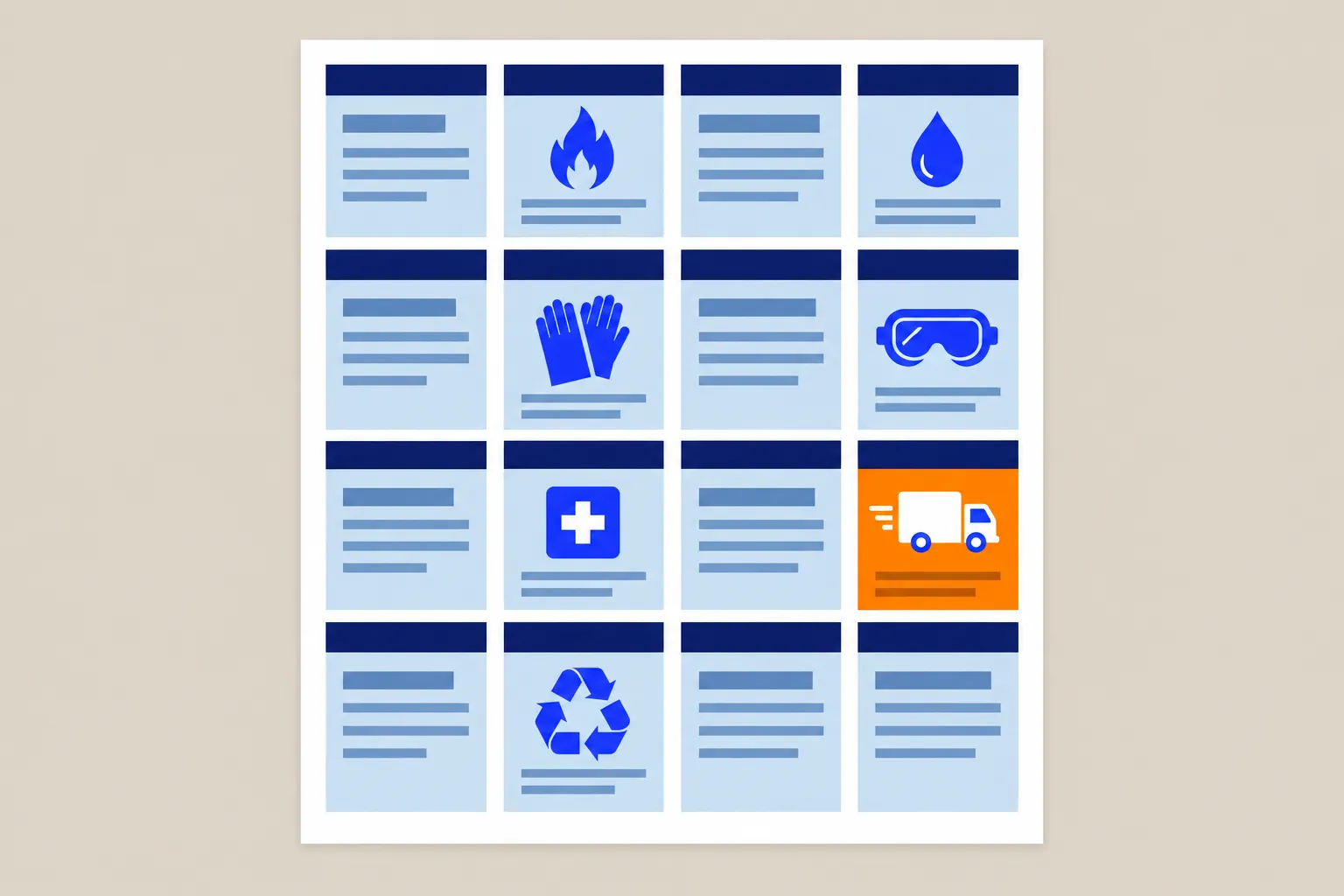
One of the most important improvements introduced with SDS documentation is its standardized structure.
Every OSHA-format Safety Data Sheet (SDS) follows the same 16-section order, allowing employees and logistics professionals to find specific information without searching through differently organized documents.
Sections 1 to 8: Identification, Hazards, and Protection
These sections focus on identifying the chemical product, understanding its hazards, and establishing appropriate safety precautions.
Section 1: Identification
Provides the product identifier, recommended uses, supplier information, and emergency contact details.
Section 2: Hazard Identification
Describes the product's classified hazards, including applicable warning statements, pictograms, signal words, and precautionary statements.
Section 3: Composition/Information on Ingredients
Identifies relevant chemical ingredients and concentrations, subject to applicable disclosure and trade-secret provisions.
Section 4: First-Aid Measures
Explains recommended first-aid procedures and when to seek medical attention after exposure through inhalation, skin contact, eye contact, or ingestion.
Section 5: Fire-Fighting Measures
Identifies suitable extinguishing methods, specific fire hazards, and recommended protective equipment for firefighters.
Section 6: Accidental Release Measures
Provides guidance for responding to spills or leaks, including containment, cleanup procedures, and personal precautions.
Section 7: Handling and Storage
Outlines safe handling practices, recommended storage conditions, and materials or substances that should be kept separate.
Section 8: Exposure Controls/Personal Protection
Includes occupational exposure limits, engineering controls, and recommended personal protective equipment.
For warehouse operations, Sections 2, 7, and 8 are particularly valuable because they help identify potential hazards, train employees, and inform appropriate handling and storage procedures.
Sections 9 to 16: Properties, Transport, and Other Information
The remaining sections provide additional technical, environmental, regulatory, and transportation-related information.
Section 9: Physical and Chemical Properties
Provides detailed information on characteristics such as appearance, odor, pH, flash point, flammability, and other relevant physical properties.
Section 10: Stability and Reactivity
Identifies conditions that may cause dangerous reactions, incompatible materials, and potentially hazardous decomposition products.
Section 11: Toxicological Information
Explains potential health effects, exposure routes, symptoms, and available toxicological data.
Section 12: Ecological Information
Provides available information about environmental effects, including aquatic toxicity and environmental persistence.
Section 13: Disposal Considerations
Discusses recommended waste handling and disposal methods.
Section 14: Transport Information
May include information such as:
- United Nations (UN) identification number
- Proper shipping name
- Transportation hazard class
- Packing group, when applicable
- Environmental hazards
- Special transportation precautions
Section 15: Regulatory Information
Identifies relevant safety, health, and environmental regulations specific to the product.
Section 16: Other Information
Typically includes the SDS preparation or revision date and other relevant information.
Important: OSHA requires the standardized 16-section format but does not enforce the SDS content requirements for Sections 12 through 15, which address subjects regulated by other agencies. These sections must appear in the prescribed order, but OSHA does not require their substantive information to be supplied.
For logistics operations, Section 14 deserves particular attention because it can help identify transportation hazards. However, the SDS alone does not ensure compliance with transportation regulations or replace an independent hazardous materials classification.
Why SDSs Matter in Logistics

Safety Data Sheets are more than regulatory paperwork. They provide crucial information that can influence warehouse operations, employee training, transportation decisions, and emergency preparedness.
For companies handling hazardous chemicals and diverse product inventories, SDS documentation helps connect product-level safety information with day-to-day logistics activities.
Warehousing and Storage
Warehouses frequently handle products with different storage requirements. Some products may be flammable, corrosive, reactive, or otherwise hazardous under certain conditions.
SDS documentation helps warehouse operators understand these risks before products enter storage.
For example, a facility receiving cleaning chemicals may need to determine whether particular products should be separated from incompatible substances or stored away from heat and ignition sources.
Section 7 of an SDS provides handling guidance and storage instructions, while Section 10 identifies stability concerns and incompatible materials.
Warehouse managers can use this information alongside applicable fire codes, OSHA safety regulations, and facility-specific safety procedures to establish appropriate storage practices.
SDS records can also support chemical inventory management by helping facilities identify which hazardous chemicals are present and where they are stored.
Under OSHA's Hazard Communication Standard, employers must maintain a list of hazardous chemicals known to be present and ensure that required SDSs are readily accessible, as paper copies or electronic files, to employees during their work shifts.
The need for specialized storage space depends on the type and quantity of hazardous materials being handled, along with applicable regulations and facility capabilities.
Shipping and Transportation
An SDS can also provide important information when determining how a product should be transported.
Some products that appear relatively ordinary in retail settings may be subject to hazardous materials transportation requirements.
Examples include:
- Aerosol sprays and pressurized containers
- Certain cleaning and disinfecting products
- Flammable liquids, including some fragrances and solvents
- Certain cosmetics and personal care products
- Some adhesives, paints, and coatings
- Certain batteries and battery-powered products
Not every product in these categories is regulated as a hazardous material for transportation. Classification depends on the product's composition, properties, packaging, and applicable transportation rules.
Section 14 of an SDS may identify a product's UN number, proper shipping name, hazard class, and packing group.
However, an SDS is not a substitute for determining the correct transportation classification under U.S. Department of Transportation (DOT) regulations.
Domestic hazardous materials transportation is governed primarily by 49 CFR Parts 171 to 180. Air shipments may also be subject to International Civil Aviation Organization (ICAO) requirements and the IATA Dangerous Goods Regulations, as applicable.
Carriers can impose additional acceptance, packaging, labeling, or documentation requirements.
For ecommerce brands, identifying these issues before inventory reaches a fulfillment center can help prevent rejected shipments, carrier restrictions, and unexpected operational delays.
Transportation requirements may also affect fulfillment costs. Products requiring specialized handling, storage, packaging, or compliance procedures can introduce additional expenses beyond standard order processing.
Learn more about how special handling requirements and other factors influence 3PL pricing.
Emergency Response
When a chemical spill, accidental exposure, or fire occurs, employees need immediate access to reliable safety information.
Safety Data Sheets help support emergency response planning by identifying the hazards associated with a product and recommending appropriate precautions.
For example:
- Section 4 explains recommended first-aid measures.
- Section 5 provides fire-fighting information.
- Section 6 describes spill and leak response procedures.
- Section 8 identifies relevant protective equipment.
These details help trained personnel evaluate potential hazards and follow established emergency procedures.
SDS information can also be valuable to firefighters and other emergency responders assessing an incident involving stored chemical products.
However, an SDS should supplement, not replace, employee training, facility emergency response plans, and professional emergency response procedures.
Who Is Responsible for Providing an SDS?
Responsibility for Safety Data Sheets is shared among several parties throughout the supply chain.
Chemical manufacturers and importers are responsible for evaluating the hazards of the chemicals they produce or import and preparing appropriate SDS documentation for hazardous chemicals.
Distributors are responsible for providing required SDS information to downstream employers and other distributors in accordance with OSHA's Hazard Communication Standard.
Employers, including warehouse operators, must maintain required SDSs for hazardous chemicals in their workplaces and ensure employees can readily access them during their work shifts.
Manufacturers and importers must also update SDS information when they become aware of significant new information about a chemical's hazards or ways to protect workers against those hazards, within the applicable regulatory timeframes.
For ecommerce brands and product distributors working with a 3PL, the practical responsibility is straightforward: provide accurate, current product safety information before inventory arrives.
This allows the fulfillment provider to review the product's handling, storage, and transportation requirements and determine whether it can support the program.
SDS documentation may also form part of broader B2B shipping and compliance processes. Depending on the products and destination, businesses may need to provide documentation such as bills of lading, certificates of origin, safety data sheets, and commercial invoices.
How to Prepare SDS Documentation for a 3PL

If your business sells products that may contain hazardous chemicals, preparing SDS documentation early can simplify onboarding with a third-party logistics provider.
Here are six practical steps to follow.
1. Identify Products That May Require an SDS
Review your product catalog and identify SKUs that contain or may contain hazardous chemicals.
Pay particular attention to aerosols, cleaning agents, flammable liquids, chemical-based products, and other items that may present safety or transportation concerns.
Remember that not every consumer product requires an SDS under OSHA. Certain exemptions may apply, including for qualifying consumer products and articles. Nevertheless, a fulfillment provider may request safety or classification documentation to evaluate a product.
2. Collect Current Documentation
Request current SDS documents from the product manufacturer, importer, or appropriate supplier.
Verify that each document corresponds to the correct product and formulation. Different formulations of products sold under similar names may have different hazard classifications.
3. Review the SDS Format and Information
Confirm that all applicable SDSs follow the standardized 16-section format.
Pay particular attention to:
- Product identification and manufacturer information
- Hazard classification
- Handling and storage recommendations
- Personal protective equipment
- Transportation information
- SDS preparation or revision date
An older revision date does not automatically make an SDS invalid, but documentation should be reviewed for SDS updates when formulations or relevant hazard information change.
4. Share SDSs During 3PL Onboarding
Provide relevant SDS documents to your fulfillment partner before shipping inventory to the warehouse.
This gives the provider an opportunity to evaluate storage conditions, handling requirements, employee safety considerations, and carrier restrictions.
Early communication is especially important for products that may require specialized storage or regulated transportation services.
5. Maintain Organized Product Records
Keep SDS documentation organized by product name, SKU, manufacturer, or other useful identifiers.
Where practical, connect SDS records to your chemical inventory and product management processes so updated SDS information can be located and distributed efficiently.
A centralized SDS library can help reduce confusion when multiple warehouses, carriers, or fulfillment partners are involved.
6. Verify Regulatory and Carrier Requirements
Finally, confirm that your products meet applicable workplace safety and transportation requirements.
SDS documentation is an important tool, but it does not replace regulatory analysis, product testing when required, or carrier-specific acceptance procedures.
For products with uncertain classifications or specialized hazards, consult a qualified hazardous materials or regulatory compliance professional about legal requirements before arranging transportation.
Partner With a Fulfillment Provider That Understands Product Handling Requirements
Understanding SDS meaning is an important first step toward safer and more efficient logistics operations.
A Safety Data Sheet communicates essential information about a product's hazards, handling requirements, storage conditions, and emergency procedures. When properly maintained and shared, these documents help businesses make informed decisions throughout the supply chain.
For ecommerce brands, manufacturers, and distributors, accurate SDS documentation can also make the transition to outsourced fulfillment more efficient by helping identify potential operational requirements before inventory arrives.
At a2b Fulfillment, we understand that effective fulfillment involves more than picking, packing, and shipping orders. It also requires thoughtful inventory management, appropriate product handling procedures, and coordination across warehousing and transportation operations.
With strategically located U.S. fulfillment facilities, advanced warehouse management technology, and a broad range of value-added services, a2b Fulfillment helps businesses build efficient, scalable distribution operations.
Whether your company is expanding its ecommerce business, supporting retail distribution, or evaluating the requirements of a specialized product category, our team can help assess your fulfillment needs and determine an appropriate operational solution.
Contact a2b Fulfillment to discuss your warehousing, order fulfillment, and distribution requirements.
FAQs
What does SDS mean in logistics?
In logistics, SDS stands for Safety Data Sheet. It is a standardized document that explains a chemical product's potential hazards, safe handling and storage requirements, recommended protective measures, and emergency procedures. SDS documentation helps warehouse operators and logistics providers evaluate product safety considerations.
Is an SDS the same as an MSDS?
An SDS serves the same general purpose as the older Material Safety Data Sheet (MSDS). However, OSHA's 2012 alignment with the Globally Harmonized System introduced a standardized 16-section SDS format. SDS is now the current terminology, although MSDS remains a commonly used legacy term.
Who is responsible for providing an SDS?
Chemical manufacturers and importers are responsible for preparing SDSs for hazardous chemicals, while distributors have obligations to pass required SDS information along the supply chain. Employers must maintain required SDSs and make them readily accessible to employees. Brands working with a 3PL should provide applicable documentation before inventory arrives.
When do you need an SDS for a product?
An SDS is generally required under OSHA's Hazard Communication Standard for hazardous chemicals covered by the regulation. Examples may include certain cleaning agents, aerosols, flammable liquids, and industrial chemical products. Some consumer products and articles qualify for exemptions. A product may also require transportation-related documentation even when OSHA does not require an SDS.
What information is included in a Safety Data Sheet?
A Safety Data Sheet contains 16 standardized sections covering product identification, hazards, chemical composition, first-aid measures, firefighting procedures, spill response, handling and storage, exposure controls, physical properties, stability, toxicology, ecological information, disposal, transportation, regulatory information, and other details. The standardized format makes safety information easier to locate and interpret.
Subscribe to receive the latest a2b Fulfillment blog posts to your inbox every week.