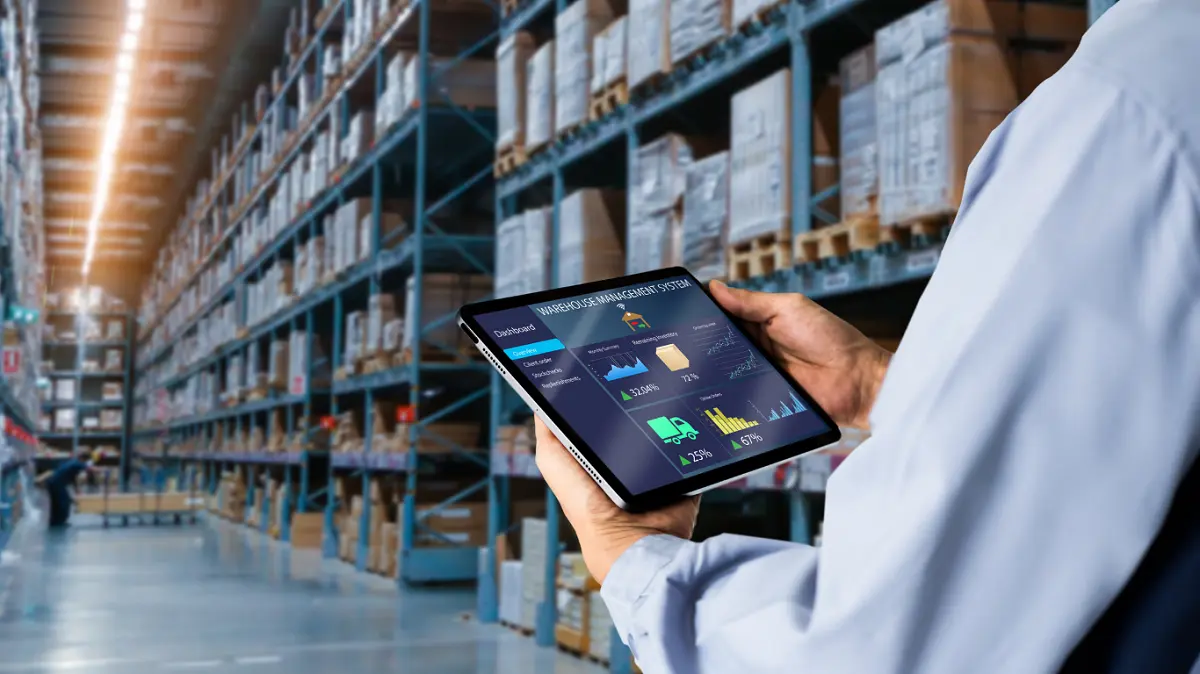


If you're comparing warehouse management system (WMS) software, you'll quickly discover that nearly every vendor claims to offer the same core features: inventory tracking, barcode scanning, order management, dashboards, and integrations.
On paper, many warehouse management systems appear remarkably similar.
In practice, they are not.
The biggest differences rarely show up on a feature checklist; they show up in the warehouse. Faster picking. Fewer touches. Higher inventory accuracy. Better labor management. Greater automation. Lower shipping costs. The reality is that the devil is in the details, and those details determine whether your WMS simply records warehouse activity or actively optimizes it.
At a2b Fulfillment, we've spent 25 years refining our warehouse management system to do far more than provide attractive dashboards. Our WMS software is engineered to continuously identify efficiencies throughout the fulfillment process, helping brands improve productivity, accuracy, and scalability while seamlessly supporting today's rapidly evolving warehouse technologies.
Why Every Warehouse Management System Isn't Created Equal
Every warehouse management system can tell you where inventory is stored.
The best warehouse management systems determine the smartest way to move it.
That distinction becomes increasingly important as businesses grow.
A basic WMS often relies on standardized workflows that treat every product, order, and warehouse process similarly. While this may work for smaller warehouses and distribution centers, complexity grows quickly as product assortments expand, customer requirements become more demanding, and order volumes increase.
A sophisticated WMS automatically adapts to those variables to maximize efficiency.
Instead of forcing warehouse workers into one-size-fits-all processes, it dynamically adjusts workflows based on product characteristics, customer requirements, shipping methods, order priorities, inventory locations, packaging rules, and countless other operational factors.
Those seemingly small optimizations compound throughout the day.
Over thousands of orders, the productivity gains become significant.
The Devil Is in the Details

The phrase "the devil is in the details" couldn't be more accurate when evaluating WMS software vs other systems.
Many solutions advertise similar functionality, but what truly separates advanced platforms is how intelligently they execute every warehouse task.
For example, a sophisticated warehouse management system can make decisions based on dozens, or even hundreds, of product and order characteristics, including:
- Product dimensions and weight
- Fragility
- Hazmat requirements
- Lot and serial tracking
- Expiration dates
- Temperature requirements
- Customer-specific routing guides
- Carrier service requirements
- Packaging rules
- Retail compliance requirements
- Inventory velocity
- Pick path optimization
- Wave priorities
These characteristic-driven workflows eliminate manual decision-making, reduce exceptions, and create highly repeatable, efficient warehouse processes.
Rather than asking warehouse associates to determine the best course of action, the WMS already knows.
That translates directly into higher productivity, fewer errors, and faster order fulfillment.
Efficiency Gains Multiply Across the Entire Warehouse Operation
The value of an advanced WMS isn't measured by one dramatic improvement.
It's measured by hundreds of small improvements happening simultaneously.
Consider just a few examples:
- Optimized pick paths reduce employee travel time.
- Intelligent wave planning balances efficiency while meeting SLAs.
- Automated replenishment minimizes stockouts.
- Carton recommendations reduce shipping and supply costs.
- Inventory slotting places fast-moving items closer to packing stations.
- Dynamic carrier selection identifies the most efficient shipping option.
- Exception handling minimizes operational delays.
- Automated quality control checkpoints reduce costly fulfillment mistakes.
Each improvement may save only seconds.
Across thousands of orders every day, those seconds become hours of labor, reduced shipping expenses, improved customer satisfaction, and increased warehouse capacity.
That's why the return on a robust WMS software can be exponential.
Advanced Technology Requires Advanced WMS Software
Warehouse technology continues to evolve rapidly.
Robotics, automation, artificial intelligence, and machine learning are reshaping modern warehouse operations.
But these technologies are only as effective as the warehouse management system coordinating them.
At a2b Fulfillment, our WMS serves as the operational hub that allows advanced technologies to work together seamlessly.
Our platform integrates with technologies including:
- Autonomous mobile robotics (AMRs)
- Goods-to-person automation
- Voice-directed picking
- Barcode scanning
- Packsize automated packaging systems
- Intelligent cartonization software
- Conveyor and sortation systems
- Multi-carrier shipping platforms
- Dimensioning equipment
- Shipping automation
Rather than operating independently, these systems communicate through the WMS to optimize every stage of fulfillment.
For example, inventory locations, robot assignments, pick sequencing, carton selection, shipping methods, and carrier labels all work together through coordinated workflows.
This orchestration dramatically improves throughput while reducing manual intervention.
Basic WMS Platforms Often Become Technology Bottlenecks
Many companies purchase an entry-level WMS because it satisfies today's requirements.
The challenge comes later.
As businesses grow, they begin adopting additional technologies:
- Robotics
- Automated packaging
- Automated storage
- Voice picking
- AI-assisted planning
- Advanced shipping software
- Business intelligence platforms
- Warehouse automation
Unfortunately, many basic warehouse management systems were never designed to support these technologies.
Limited APIs, inflexible workflows, and rigid architectures often require expensive custom development or prevent implementation altogether.
The result is fragmented operations where technology operates in data silos instead of as one coordinated system.
Modern fulfillment demands far greater flexibility.
Your WMS should become the foundation for future innovation, not the obstacle preventing it.
Integration Matters More Than Ever

No warehouse management system operates alone.
Today's fulfillment environment depends on seamless communication between many business systems.
a2b Fulfillment's software solutions were designed with integration in mind.
Our platform easily connects with:
- Shopify
- BigCommerce
- WooCommerce
- Amazon
- Walmart Marketplace
- ERP systems
- Order Management Systems (OMS)
- EDI platforms
- Business intelligence tools
- UPS, FedEx, DHL, USPS, and all other popular carriers
- Multi-carrier shipping systems
- Customer service platforms
- Voice Picking and Robotics
- Automation Control Systems
This connectivity allows inventory, orders, shipping data, tracking information, and operational reporting to flow automatically between systems, eliminating manual data entry and improving visibility across the supply chain.
As new technologies emerge, integration flexibility becomes even more valuable.
Beyond Inventory Management: What a Sophisticated WMS Really Does
Many businesses think of warehouse management software primarily as an inventory tracking system.
In reality, a modern WMS orchestrates nearly every warehouse flow.
a2b Fulfillment's WMS supports capabilities including:
- Real-time inventory visibility
- Inventory management across multiple warehouses
- Lot and serial number tracking
- Directed putaway
- Intelligent replenishment (min/max, forecasted, and emergency)
- Cycle counting
- Wave, batch, and zone picking
- Mobile barcode scanning
- Voice-directed workflows
- Robotics
- Automated quality verification
- Cartonization and packaging optimization
- On-Demand packaging
- Shipping rate shopping
- Multi-carrier label generation
- Retail compliance workflows
- Returns processing
- Value-added services
- Kitting and assembly
- Reporting and business intelligence
- Labor productivity tracking
Individually, each feature adds value.
Together, they create a warehouse operation that is faster, more accurate, and significantly more scalable than one relying on basic warehouse software.
Build, Buy, or Leverage a Proven Platform?
If you're evaluating WMS software, you generally have three options.
Build a custom solution, which offers flexibility but requires significant investment and ongoing development.
Buy commercial WMS software, then invest in implementation, hardware, integrations, training, and long-term maintenance.
Or partner with a technology-enabled 3PL that already operates enterprise-grade warehouse management software.
For many growing brands, the third option delivers the greatest value.
When you partner with a2b Fulfillment, you gain access to sophisticated warehouse technology without purchasing software licenses, hiring WMS specialists, managing infrastructure, or maintaining integrations yourself.
Instead, you benefit from a continuously evolving fulfillment platform that's already optimized for high-volume, omnichannel operations.
Final Thoughts
Choosing WMS software isn't simply about comparing features; it’s about understanding how intelligently those features work together. The greatest efficiency gains come from the countless operational decisions an advanced warehouse management system makes every day, often without anyone noticing.
At a2b Fulfillment, our warehouse management system has been refined over 25 years of real-world fulfillment experience. Combined with robotics, advanced automation, voice picking, cartonization, on-demand packaging technology, multi-carrier shipping platforms, and seamless integrations, it delivers efficiencies that extend far beyond inventory tracking and dashboards. It's a platform built to help growing brands scale faster, operate smarter, and stay ready for whatever warehouse technology comes next.
Frequently Asked Questions
What makes one WMS software better than another?
The biggest differences aren't found in feature lists; they're found in workflow sophistication. Advanced WMS systems automate operational decisions, optimize warehouse processes based on product and order characteristics, and integrate seamlessly with automation technologies that basic systems often struggle to support.
Can a WMS improve warehouse efficiency even if inventory accuracy is already high?
Yes. While inventory accuracy is essential, advanced WMS systems also optimize labor, picking paths, packaging, replenishment, shipping decisions, and warehouse workflows. These incremental improvements compound over time, creating significant productivity gains.
Why are integrations so important in modern warehouse operations?
Today's warehouses rely on interconnected technologies, including e-commerce platforms, ERP systems, robotics, voice picking, automated packaging, warehouse automation and sortation, advanced reporting, and shipping software. A WMS that integrates easily with these systems provides greater operational visibility, reduces manual work, and enables future automation initiatives.
Is it better to buy WMS software or partner with a 3PL?
It depends on your business model and operational strategy. Companies that want complete control of their warehouse may benefit from owning a WMS, while many growing brands find it more cost-effective to partner with a technology-enabled 3PL like a2b Fulfillment, gaining access to enterprise-grade warehouse technology without the costs and complexity of purchasing, implementing, and maintaining it themselves.