

The launch of Amazon Supply Chain Services changes the competitive landscape for carriers, 3PLs, and brands alike. Here is an objective look at what ASCS is, who it affects, and what questions leaders should be asking right now.
On May 4, 2026, Amazon made an announcement that sent shockwaves through the logistics industry. The company launched Amazon Supply Chain Services (ASCS), a platform that extends Amazon's fulfillment network and full logistics infrastructure to any business, regardless of whether that business sells on Amazon's marketplace. For operations and supply chain executives, this is not a story about one company's press release. It is a signal that the logistics industry is entering a new phase of competition.
Understanding what ASCS is, what it is not, and how it compares to existing options is essential for making sound strategic decisions in the months ahead.
What are Amazon Supply Chain Services?
ASCS consolidates multiple logistics capabilities into a single, cloud-enabled platform. According to Amazon's official announcement, the service covers full truckload, less-than-truckload (LTL), and intermodal freight; air freight; inbound ocean shipping from China, including customs clearance; 2-to-5-day parcel delivery; and bulk storage and distribution across more than 200 U.S. fulfillment centers. Amazon's transportation assets supporting the platform include more than 80,000 trailers, 24,000 intermodal containers, and over 100 aircraft.
The offering is designed to be modular. As Amazon stated in its launch materials, businesses can adopt one service, a few, or all of them, and scale up or down as their needs change. The pitch is straightforward: access enterprise-grade logistics without building your own network.
"Amazon is bringing the infrastructure, intelligence, and scale of its supply chain services—proven over decades—to businesses everywhere, much like Amazon Web Services did for cloud computing." - Peter Larsen, VP of Amazon Supply Chain Services
Major brands have already signed on. Procter & Gamble is using Amazon's freight services to move goods and raw materials. 3M is leveraging freight capabilities. American Eagle Outfitters is tapping parcel shipping for direct-to-consumer delivery. Lands' End is using ASCS to unify inventory management across multiple sales channels and position products closer to customers ahead of peak seasons.
The Market Reaction Was Swift
Investors immediately recognized the implications. UPS and FedEx shares each fell roughly 9 to 10 percent on the day of the announcement, according to multiple industry reports. Logistics companies, including GXO and Forward Air, also saw double-digit declines. Amazon's stock, meanwhile, reached a record high. Citibank equity analyst Ariel Rosa noted in a client note that companies with hard assets, quality offerings, and entrenched customer relationships will remain competitive, with the biggest risk falling to asset-light logistics providers.
That assessment aligns with what supply chain experts have observed. The market reaction may have been dramatic, but the actual disruption will likely be uneven across different types of providers.
What This Means for Carriers
For large integrated carriers like UPS and FedEx, the primary near-term threat is pricing pressure. Amazon already surpassed the U.S. Postal Service as the top domestic parcel delivery provider by volume in 2025. Adding non-Amazon volume through ASCS will only increase that scale advantage. Parcel analyst Nate Skiver of LPF Spend Management noted that smaller alternative carriers, whose primary competitive tool is low pricing, face the most direct risk. They have fewer differentiation options when competing against a provider with Amazon's cost structure and reliability data.
Asset-light freight brokers and forwarders serving small and mid-size retail customers are also worth watching. As one industry expert warned in FreightWaves reporting, those operators will need to demonstrate personalized service capabilities that a technology-driven platform cannot easily replicate.
What This Means for 3PLs
The impact on third-party logistics providers is more nuanced. ASCS does compete directly with what traditional 3PLs offer, particularly in e-commerce fulfillment and parcel delivery. For many brands, especially those already selling on Amazon, there is a real possibility that ASCS delivers meaningful cost savings.
However, market observers, including Matthew Hertz, CEO of Third Person, a 3PL matchmaker for brands, do not see ASCS as an immediate replacement for established 3PL relationships. Hertz expects Amazon to grow organically over the next several years, steadily taking market share rather than displacing incumbents overnight.
Where 3PLs face the greatest pressure is in mid-market accounts that require standard services and are price-sensitive. For more complex operations involving customization, returns management, value-added services, regulated goods, or deep systems integration, the calculus is different. ASCS is a capable platform, but it is also a standardized one. Complexity and customization are not its natural strengths.
What This Means for Brands
For operations and supply chain leaders at brand companies, ASCS introduces a genuine fourth option in the fulfillment decision framework. Historically, the choices were: build your own distribution network, outsource to a 3PL, or sell through Amazon and use FBA. ASCS now allows brands to access Amazon's network without being locked into the Amazon marketplace or surrendering customer data and margin.
That is a meaningful change. Brands that currently use multiple providers for freight, warehousing, and parcel delivery now have a single-vendor alternative. For some, that simplicity and the data tools that come with it, including AI-powered demand forecasting, will be attractive. For others, the risk of becoming deeply dependent on Amazon's infrastructure while competing with Amazon's own retail business will give them pause.
According to Gartner projections cited in recent industry analysis, 30 percent of large enterprises will shift at least 20 percent of their freight spend to integrated logistics platforms by 2027. That shift is already beginning.
ASCS vs. Traditional 3PL: Service Capability Comparison
The table below provides a side-by-side view of service capabilities across both models. It is designed to help operations leaders quickly identify where the two approaches align and where meaningful gaps exist.
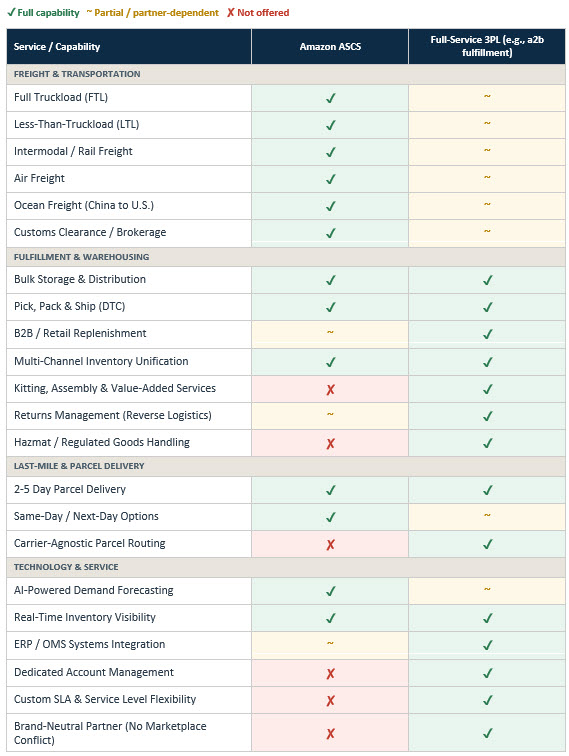
Note: 3PL capabilities vary by provider. This chart reflects capabilities typical of a full-service domestic 3PL. ASCS capabilities are based on Amazon's May 2026 launch documentation. "Partial" indicates the service exists but with limitations or through third-party arrangements.
The Questions Operations Leaders Should Be Asking
Before evaluating ASCS as a potential solution, operations and supply chain leaders should work through a clear set of questions. First, how standardized is your fulfillment operation? ASCS works well for brands with relatively clean SKU profiles, predictable volumes, and straightforward pick-and-ship workflows. The more customized or complex the operation, the more a purpose-built 3PL relationship may hold its advantage.
Second, what is your risk tolerance around data and competitive exposure? Amazon is both a potential logistics partner and, for many brands, a marketplace competitor. Sharing inventory data and supply chain patterns with Amazon carries strategic implications that go beyond logistics cost. This concern is real and worth examining carefully before committing to deep integration.
Third, is the cost savings proposition as clear as it appears? For some brands, particularly those with high parcel volumes and simple distribution needs, ASCS may deliver genuine savings. For others, the total cost of transitioning, including systems integration, relationship disruption, and reduced flexibility, could offset headline rate improvements.
Finally, what happens if Amazon prioritizes its own marketplace fulfillment over ASCS clients during peak periods? Supply Chain Dive reporting noted that questions around capacity allocation remain unanswered for early adopters. How Amazon balances its own operations versus third-party clients when capacity is constrained is an open question that deserves scrutiny before any strategic commitment.
Where Independent 3PLs Still Hold the Advantage
The capability chart above makes the differences visible. ASCS excels at scale, integrated technology, and end-to-end visibility across a national network. Where full-service 3PLs continue to hold a clear edge is in flexibility and customization: value-added services like kitting and assembly, dedicated account management, carrier-agnostic routing, custom SLAs, handling of regulated or hazmat goods, and the absence of marketplace conflicts.
For brands that require a true operational partner, not just a logistics platform, those differences matter. A 3PL that is deeply integrated into your systems, understands your product mix, and can adapt to your business needs offers something that a standardized platform, however capable, cannot fully replicate.
The ASCS launch does not change the fundamental value proposition of a strong 3PL relationship. It does raise the bar for every 3PL to demonstrate that value clearly and consistently.
The Bottom Line
Amazon Supply Chain Services is a serious offering backed by real infrastructure and real scale. For operations leaders, it deserves honest evaluation, not dismissal. At the same time, it is not a universal solution. The brands best positioned to benefit are those with high volume, straightforward fulfillment needs, and a comfort level with Amazon's ecosystem. For everyone else, the decision requires careful analysis of tradeoffs that go well beyond per-unit logistics costs.
The supply chain landscape is more competitive than it was a week ago. That is good for shippers who want more options and more pricing leverage. It also means that choosing the right partner, not just the lowest-cost platform, will matter more than ever.
At a2b fulfillment, we work with operations and supply chain teams to evaluate their fulfillment strategies in light of exactly these kinds of market shifts. If your team is working through how ASCS fits, or does not fit, into your network strategy, we are glad to have that conversation.
About the Author
Sarah Smith is Vice President of Marketing at a2b Fulfillment, where she leads brand strategy, content, and sales enablement for one of the industry's most operationally focused third-party logistics providers. With more than 10 years of experience spanning marketing and logistics, Sarah brings a ground-level understanding of what eCommerce brands need from a fulfillment partner. Her writing covers 3PL technology, DTC and B2B fulfillment operations, supply chain strategy, and the evolving demands of modern eCommerce.