

AMERICA AT 250 - A Four-Part Blog Series
Still Setting the Standard: Why American Logistics and Supply Chain Leadership Endures
From the first steamboat churning up the Mississippi to the AI-powered fulfillment centers redefining how the world shops, American ingenuity has never stopped moving goods, ideas, and possibilities forward. As the United States marks 250 years of independence in 2026, this series reflects on how a young nation built the most dynamic economy in history, starting from the ground up, one invention, one innovation, and one shipment at a time.
Anchored in McKinsey Global Institute's 2026 report, "At 250, Sustaining America's Competitive Edge," each installment in this series explores a chapter of that story and looks forward to what comes next.
Series Overview
- Blog 1: Built to Move: How American Supply Chain and Logistics Powered 250 Years of Growth
- Blog 2: Click, Ship, Repeat: How America Invented the Ecommerce Era and Changed Global Commerce
- Blog 3: The Road Ahead: Navigating Complexity and Planning for the Next Era of American Logistics
- Blog 4: The Next Frontier: Humanoid Robotics, AI, and Why America's Best Days in Logistics Are Ahead
Built to Move
How American Supply Chain and Logistics Powered 250 Years of Growth
In the summer of 1776, the ink was barely dry on the Declaration of Independence when the new nation's founders faced a practical question: how do you build a country? The answer, it turned out, was infrastructure. Roads, rivers, railroads, and eventually the interstate highway system became the circulatory system of American ambition. Supply chain and logistics were not just supporting players in America's rise. They were the engine.
As the United States turns 250, it is worth pausing to appreciate what this country built, invented, and shipped into existence. According to McKinsey's landmark 2026 report "At 250, Sustaining America's Competitive Edge," Americans created or contributed to 76 of the 100 most important innovations of the past 250 years. A remarkable number of those innovations were about moving things: people, goods, energy, and information.
"We the people, farmers in the fields, tinkerers in backyard workshops, machinists at forges, developers pulling all-nighters, have built an American economic powerhouse." - McKinsey Global Institute, 2026
From Steamboats to Standardized Containers

The story begins with geography. The United States was blessed with more navigable waterways than virtually any other large economy, plus deep harbors on two oceans. Benjamin Franklin recognized it as early as 1767, writing that America was "favour'd by Nature with all Advantages of Climate, Soil, great navigable Rivers and Lakes." Those rivers became the first logistics network.
Robert Fulton's commercial steamboat, launched in 1807, transformed inland waterways into reliable commercial arteries. Goods that once took weeks to move by flatboat could now travel upstream against the current on a predictable schedule. It was one of the first times in history that logistics moved from ad hoc to reliable, and it came from an American workshop.
Railroads followed, and with them, something even more profound: the concept of national supply chain integration. By the 1860s, the transcontinental railroad connected the coasts, and a nation that once relied on seasonal river travel could move cattle, grain, coal, and manufactured goods year-round on a standardized network. The federal government supported railroad expansion through land grants, a model of public-private partnership in infrastructure that the world would study and replicate for generations.
Then came the assembly line. Henry Ford did not just build cars. He invented the modern logistics flow. By standardizing parts, sequencing production, and synchronizing material delivery to the line in exactly the right order at exactly the right time, Ford pioneered what we now call lean manufacturing and just-in-time supply chain principles. The Ford River Rouge Complex was, in its day, the most integrated supply chain in human history, with raw materials entering one end and finished vehicles exiting the other.
The Container That Changed Everything
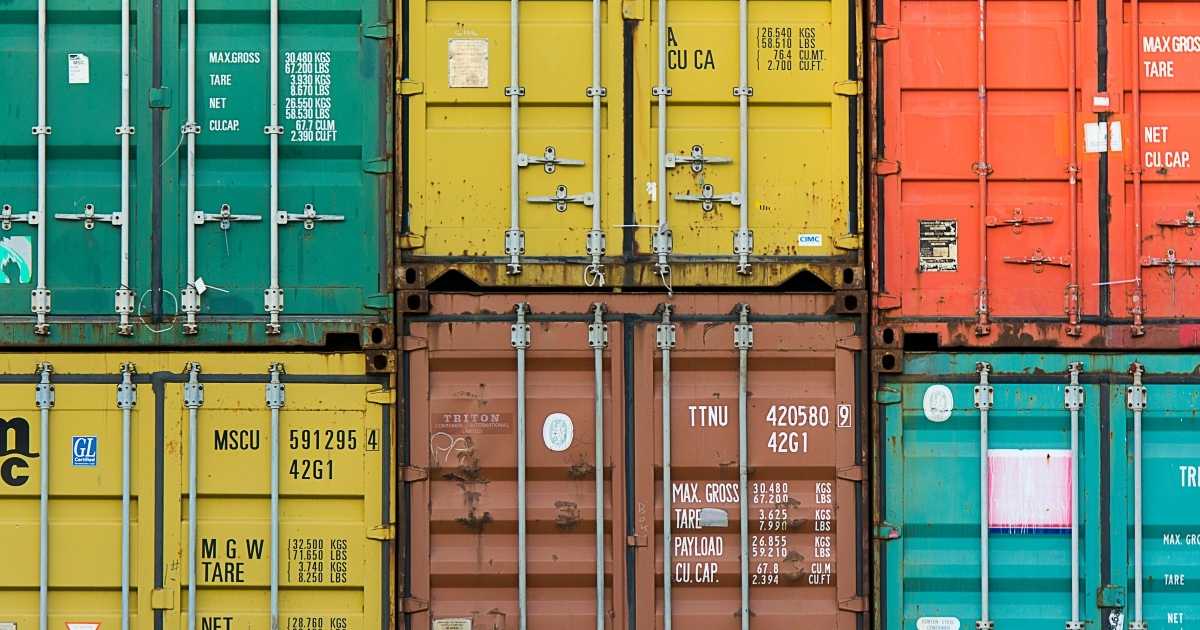
If Ford reorganized factory logistics, Malcolm McLean reorganized global logistics. In 1956, this North Carolina trucker had a simple but revolutionary idea: instead of loading and unloading individual cargo items at ports, why not put everything in a standardized steel box that could move seamlessly between ships, trains, and trucks? The intermodal shipping container was born.
The impact was staggering. Port handling costs dropped by more than 90 percent. Ships that once took days to load and unload could be turned around in hours. Global trade volumes exploded. The modern world of international supply chains, the one that lets a consumer in Ohio buy goods manufactured in Vietnam, simply would not exist without an American trucker's idea on a New Jersey dock.
The container did not just change shipping. It enabled the globalization of manufacturing, the offshoring of production, and ultimately the rise of the third-party logistics industry that companies like a2b Fulfillment represent today. Every warehouse, every pick-and-pack operation, every international freight forwarder traces a direct line back to that steel box.
The Science of Warehousing and Distribution

American innovation continued to redefine logistics from the inside out. In the 1970s and 1980s, advances in warehouse management systems, barcode scanning, and electronic data interchange allowed companies to track inventory in real time for the first time. What had been a manual, error-prone process became a data-driven science.
UPS and FedEx, both American companies, transformed parcel delivery from a slow and unpredictable process into a reliable, trackable system with guaranteed service levels. FedEx's hub-and-spoke model, introduced in the 1970s, became the architectural blueprint for modern last-mile logistics networks worldwide. The concept that a package dropped off in Des Moines today could be in Dallas tomorrow was not just operationally impressive. It redefined consumer expectations.
Meanwhile, Walmart quietly built one of the most sophisticated supply chains in retail history. By investing heavily in its own logistics infrastructure, satellite communications for supplier connectivity, and cross-docking distribution centers, Walmart achieved cost efficiencies that reshaped American retail and forced global competitors to modernize or fall behind. The "everyday low price" was not a marketing slogan. It was a supply chain achievement.
A Platform for the World

McKinsey's research makes clear that the United States did not simply participate in the global economy. It architected it. The country's freight infrastructure today supports the longest freight railroad network in the world, the second-largest highway system, and a port network with access to two oceans and the Gulf of America. That physical backbone made the United States the natural hub for global trade routes.
By the early 21st century, American companies accounted for nearly 60 percent of the top 100 global firms by market capitalization, and a disproportionate share of those companies relied on sophisticated, American-designed supply chains to deliver their products worldwide. The competitive advantage was not just in the products. It was in the operational excellence behind them.
The United States accounts for just 4 percent of the global population but generates 26 percent of global GDP. That disproportion is not an accident. It is the compound result of 250 years of logistics innovation.
The 3PL Revolution
The rise of third-party logistics providers is itself an American story. As companies grew more sophisticated about their core competencies, they recognized that warehousing and fulfillment, while critical, were not where their competitive advantage lived. Outsourcing logistics to specialized partners who could deliver scale, technology, and operational expertise became the smart play.
The 3PL industry grew from a niche service into a multi-hundred-billion-dollar sector, and American providers led the way in developing the operational systems, technology platforms, and customer service standards that define the industry globally. The innovation did not stop with physical operations. It extended into data, visibility, and the kind of supply chain intelligence that helps businesses make smarter decisions, faster.
Two hundred and fifty years after the founding fathers pledged their lives and fortunes to each other, the spirit of that bet lives on in every loading dock, every distribution center, and every real-time tracking dashboard. America did not just build a nation. It built the infrastructure that moves the world.
About the Author
Sarah Smith is Vice President of Marketing at a2b Fulfillment, where she leads brand strategy, content, and sales enablement for one of the industry's most operationally focused third-party logistics providers. With more than 10 years of experience spanning marketing and logistics, Sarah brings a ground-level understanding of what eCommerce brands need from a fulfillment partner. Her writing covers 3PL technology, DTC and B2B fulfillment operations, supply chain strategy, and the evolving demands of modern eCommerce.