

Part 4 of 4 Part blog series celebrating America at 250.
Blog 1: Built to Move: How American Supply Chain and Logistics Powered 250 Years of Growth
Blog 2: Click, Ship, Repeat: How America Invented the Ecommerce Era and Changed Global Commerce
Blog 3: The Road Ahead: Navigating Complexity and Planning for the Next Era of American Logistics
Blog 4: The Next Frontier: Humanoid Robotics, AI, and Why America's Best Days in Logistics Are Ahead
Humanoid Robotics, AI, and Why America's Best Days in Logistics Are Ahead
Two hundred and fifty years ago, a group of farmers, lawyers, and merchants signed a document that changed the trajectory of human history. They had no guarantee it would work. They had no model to follow. They had only a belief that free people, given the right conditions and the freedom to innovate, could build something the world had never seen before.
That belief is still being tested. And the evidence, by nearly every meaningful measure, suggests it is still passing.
McKinsey's 2026 research on American competitiveness captures something remarkable: a country with 4 percent of the world's population generates 26 percent of global GDP, is home to 59 of the world's top 100 companies by market capitalization, accounts for 51 percent of the world's notable AI models, and spends 27 percent of global R&D dollars. These are not the numbers of a country in decline. They are the numbers of a country at the leading edge of another great transformation.
That transformation has a name: embodied AI. And it may be the biggest logistics revolution since the shipping container.
The Rise of Humanoid Robotics
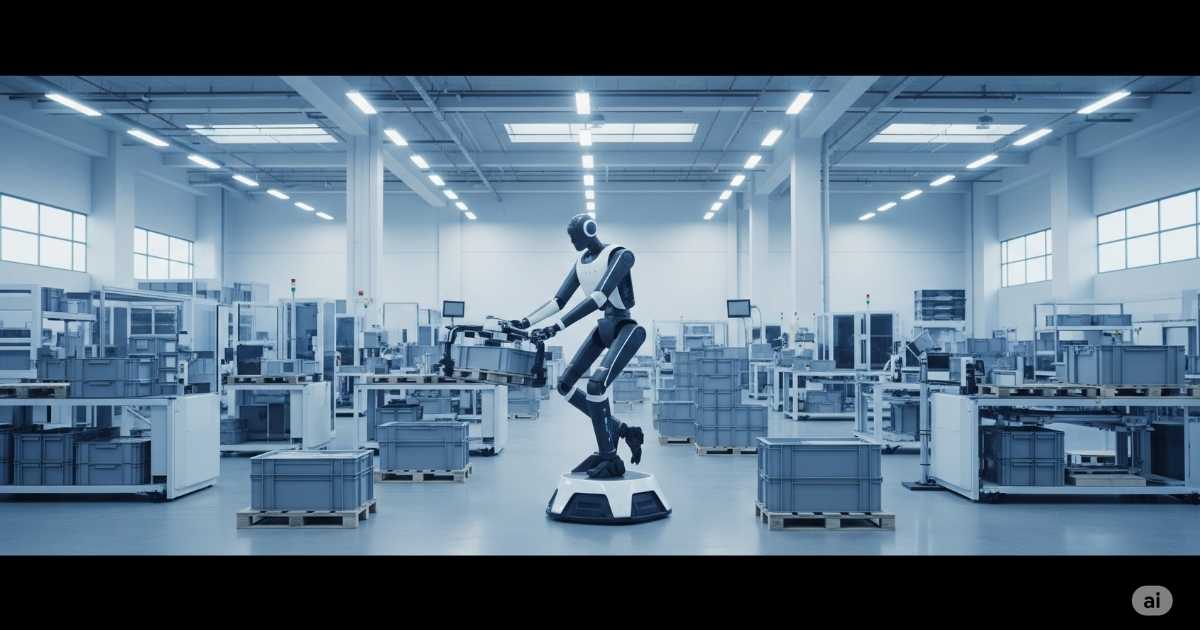
For decades, robotics in logistics meant specialized machines doing narrow, repetitive tasks: robotic arms welding on assembly lines, automated guided vehicles moving pallets in warehouses, conveyor systems sorting packages. These tools were powerful but inflexible. They required significant capital investment, precisely configured environments, and extensive reprogramming for even minor operational changes.
Humanoid robots are different in kind, not just degree. A humanoid robot designed to work in a logistics environment can, in principle, do what a human worker does: navigate unpredictably cluttered spaces, pick items of varying sizes and shapes, handle exception cases, respond to verbal instructions, and adapt to changing conditions in real time. The warehouses and distribution centers of today, built to accommodate human workers, could operate with humanoid robots without expensive redesign.
McKinsey's research cites estimates that approximately 57 percent of American hours worked could theoretically be performed by agents and robots with near-future technology. In logistics specifically, the percentage is likely higher, given the physical, repetitive, and predictable nature of many warehouse tasks. The question is not whether humanoid robotics will transform logistics. It is who will lead that transformation.
The next 250 years of American logistics will not be built with steel and concrete alone. They will be built with silicon, software, and the same stubborn belief that we can always find a better way.
America's AI Advantage

The United States enters the humanoid robotics era with structural advantages that are difficult to replicate. American companies, universities, and research institutions have been developing the foundational AI models, computer vision systems, and robotic manipulation algorithms that humanoid robots will depend on. McKinsey documents that American firms lead globally in investment in frontier technologies, with private-sector investment in AI, biotechnology, and robotics exceeding $1 trillion between 2021 and 2024.
Companies like Boston Dynamics, which pioneered legged robotics, and a new generation of startups focused specifically on logistics applications are building capabilities that position the United States to lead in the deployment of humanoid systems. The venture capital ecosystem that funded the internet, then mobile computing, then cloud services, is now funding embodied AI with the same conviction.
The competitive race is real. China has made significant investments in robotics and currently operates more industrial robots than the rest of the world combined. Chinese firms are integrating AI into physical systems in ways that American companies should take seriously. But the United States has assets that are genuinely difficult to match: the world's most sophisticated AI research ecosystem, universities that attract the best engineering talent globally, and a culture of commercialization that turns research into deployable products faster than any other country.
The Logistics Industry at the Inflection Point

For the logistics industry specifically, the humanoid robotics era represents both a challenge and a historic opportunity. Companies that have built strong operational foundations, deep client relationships, and the institutional knowledge to manage complex supply chains are positioned to integrate new technologies effectively. Companies that are still fighting the last war, optimizing for the previous era's competitive environment, face serious disruption risk.
The 3PL providers that will thrive in this environment are investing now. Not just in robotics hardware, but in the data infrastructure, workforce training, and operational redesign that successful technology deployment requires. Automation is not a plug-and-play solution. It requires understanding which tasks benefit most from automation, which require human judgment, and how to design workflows that optimize the collaboration between human workers and robotic systems.
That integration challenge is itself an area where American operational expertise provides an advantage. The institutional knowledge of how American logistics operations run, the relationships with American brands and carriers, and the track record of managing complex fulfillment at scale are not replicable overnight. Technology may level some playing fields, but deep operational expertise remains a durable competitive moat.
The Foundation Holds

Step back from the technology for a moment, and what McKinsey's research describes is something profound: a country whose competitive advantages are, at their deepest level, cultural and institutional rather than merely technological. The entrepreneurial spirit that drove Eli Whitney to invent the cotton gin, Henry Ford to perfect the assembly line, Malcolm McLean to design the shipping container, and Jeff Bezos to bet his career on an internet bookstore is still producing new generations of founders, builders, and problem-solvers.
The physical infrastructure is still the most capable freight network in the world. The financial system is still the deepest and most trusted source of growth capital on earth. The universities are still the global magnet for top engineering talent. And the culture, that irreplaceable, hard-to-define American willingness to try something that has never been done before, is still very much alive in the research labs, the startup garages, and the warehouse floors where the next chapter of logistics is being written right now.
None of this is cause for complacency. McKinsey is clear that sustaining the competitive edge will require deliberate investment in workforce development, infrastructure, energy capacity, and fiscal health. The challenges are real and the competition is serious. But the foundation is real too.
America did not build its competitive advantage through one invention, one company, or one generation. It built it through 250 years of refusing to accept that the current way is the best way.
A Note for the Industry

For those of us in logistics and supply chain, the 250th anniversary of American independence is worth more than a passing acknowledgment. Our industry is not a footnote to the American economic story. It is a central chapter in it.
The steamboat, the railroad, the container, the fulfillment center, the real-time tracking system, the AI-powered demand forecast: these are not just technological milestones. They are expressions of a national character that believes goods should move faster, supply chains should be smarter, and the distance between a product and the customer who wants it should keep shrinking.
That belief is still the right one. And if history is any guide, the next 250 years of American logistics will be even more remarkable than the last.
Happy birthday, America. We are still just getting started.
Sources: McKinsey Global Institute, "At 250, Sustaining America's Competitive Edge," March 2026. McKinsey Global Institute, "Agents, Robots, and Us: Skill Partnerships in the Age of AI," November 2025. McKinsey Global Institute, "The Next Big Arenas of Competition," October 2024. Stanford HAI, "The AI Index 2025 Annual Report," April 2025. National Venture Capital Association, NVCA 2025 Yearbook, March 2025.
About This Series
This four-part blog series was developed by a2b Fulfillment to mark the 250th anniversary of American independence and to explore the role that logistics and supply chain innovation has played in the American competitive story. Content is informed by McKinsey Global Institute's March 2026 report, "At 250, Sustaining America's Competitive Edge," as well as supporting McKinsey research and publicly available industry data.
About the Author
Sarah Smith is Vice President of Marketing at a2b Fulfillment, where she leads brand strategy, content, and sales enablement for one of the industry's most operationally focused third-party logistics providers. With more than 10 years of experience spanning marketing and logistics, Sarah brings a ground-level understanding of what eCommerce brands need from a fulfillment partner. Her writing covers 3PL technology, DTC and B2B fulfillment operations, supply chain strategy, and the evolving demands of modern eCommerce.