


Earning the Amazon Prime badge is one of the most effective ways to boost visibility and conversions. For years, Fulfillment by Amazon (FBA) was the only path. Now, for high-volume brands, Seller Fulfilled Prime (SFP) offers a more profitable and flexible alternative, if you can meet its demanding requirements.
Attempting to qualify for SFP in-house is a monumental task fraught with risk. The secret to success lies in partnering with a qualified 3PL that has the infrastructure, technology, and expertise to guarantee compliance. This guide outlines the exact steps for qualifying for SFP with a logistics partner, turning a complex process into a clear roadmap for profitable growth.
1. Understanding Amazon's SFP Requirements

Before you begin, it’s crucial to understand the non-negotiable standards Amazon sets. The entire program is built on a promise to the customer, and Amazon enforces it strictly.
- The 30-Day Trial Period: To earn the Prime badge, you must successfully complete a trial period where you fulfill a set number of Prime orders while meeting all performance targets.
- Core Performance Metrics: During the trial and forever after, you must maintain:
- On-Time Shipment Rate of >99%: Nearly every Prime order must ship on or before its promised ship date.
- Valid Tracking Rate of >99%: Orders must be shipped using Amazon-approved carriers, and tracking information must be provided.
- Cancellation Rate of<1%: You must maintain sufficient inventory to fulfill orders, as canceling them will quickly lead to suspension.
- Nationwide Delivery Coverage: You must offer 1-day or 2-day delivery options to a significant portion of the continental US, which requires a strategic fulfillment network.
- Use of Approved Carriers: All SFP orders must be shipped via approved carriers (like UPS and USPS) through Amazon’s Buy Shipping services.
These metrics leave no room for error. A single bad day can jeopardize your status. This is why partnering with an expert 3PL is not just a convenience, it's a necessity.
2. The Pre-Assessment Checklist: What to Prepare
A successful SFP transition starts with data. Before engaging a 3PL, gather the following information to facilitate a productive assessment and build a strong business case.
- Product Catalog Analysis: Identify your full range of SKUs, noting which are bestsellers, which are slow-movers, and which have seasonal demand.
- Dimensions and Weights: Accurate weights and dimensions for your top products are essential for modeling shipping and storage costs.
- Order Geography: Where do your customers live? A heat map of your order destinations will determine the optimal warehouse locations for your inventory.
- Returns Profile: Analyze your current return rates and reasons. This data helps your 3PL partner design a more efficient and cost-effective reverse logistics process.
- Existing Tech Stack: List the e-commerce platforms (Shopify, BigCommerce), ERPs, and inventory management systems you currently use. This helps map out the integration plan.
3. Designing Your SFP Fulfillment Network
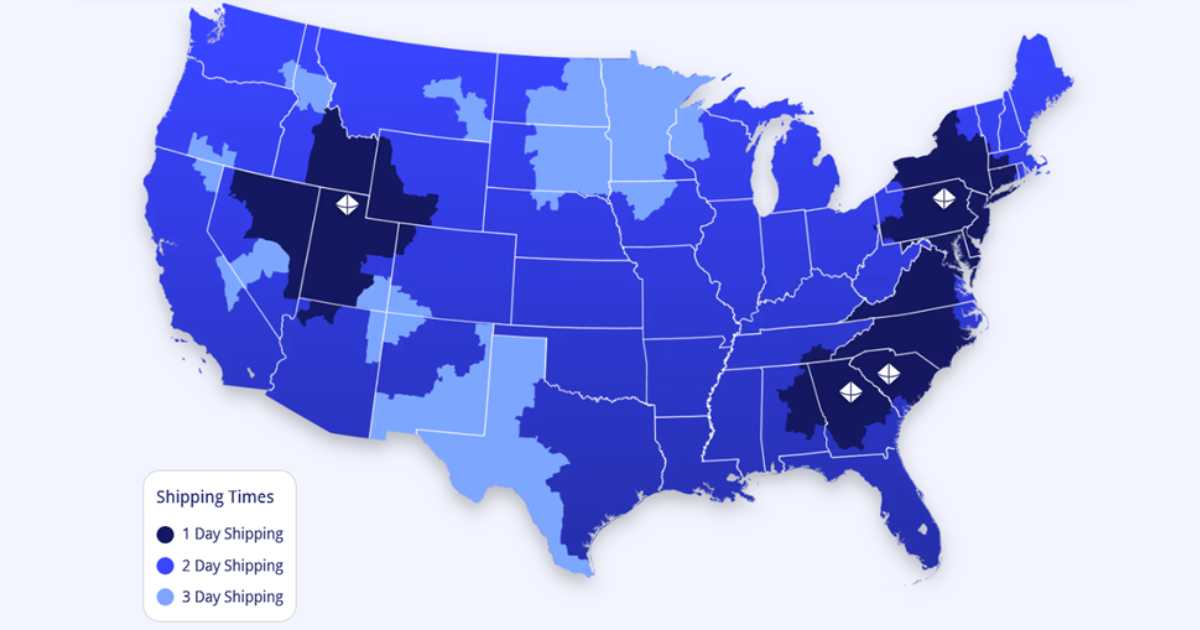
The key to meeting SFP's speed requirements profitably is a distributed inventory strategy. A single warehouse is no longer sufficient for nationwide 2-day delivery. Your 3PL partner will help you design a network based on your specific needs.
- 1-2 Day Coverage Map: The goal is to place inventory in strategic locations to reach the majority of the US population within 2 days via ground shipping. A common strategy involves using two or three warehouses (e.g., one on the East Coast, one on the West Coast, and one in the Midwest).
- Node Strategy: Based on your order heat map, your 3PL will recommend the ideal fulfillment centers ("nodes") to stock your products. This minimizes shipping zones and reduces costs.
- Carrier Mix and Cutoff Times: Your partner will manage relationships with SFP-approved carriers and establish aggressive order cutoff times (e.g., 2 PM in the local time zone) to maximize the number of orders shipped the same day.
- Packaging Standards: Define packaging requirements to ensure products are protected while optimizing for dimensional weight, keeping shipping costs low.
4. SOPs to Ace the 30-Day Trial
Your 3PL partner will already have standard operating procedures (SOPs) designed for SFP compliance. These are the operational pillars that ensure you pass the trial and maintain your badge.
- Pick and Pack SLAs: Service Level Agreements that guarantee orders are picked, packed, and ready for carrier pickup within hours of receipt.
- Rigorous Quality Assurance: A multi-point check system to verify that the right item is in the right box with the right shipping label, eliminating errors.
- Exception Handling: A clear protocol for managing unexpected issues like a carrier delay or a damaged product, ensuring problems are resolved before they impact your metrics.
- Inventory Accuracy and Forecasting: Daily cycle counts and integrated forecasting tools to maintain near-perfect inventory accuracy, making the <1% cancellation rate achievable.
5. Seamless Technology Integration
Technology is the backbone of a successful SFP operation. Your 3PL should provide robust integrations that create a seamless flow of information between your systems, their warehouse, and Amazon.
This includes:
- Direct API Integration with Amazon Seller Central: This allows for real-time order syncing, inventory updates, and tracking information pass-back.
- Warehouse Management System (WMS): The WMS orchestrates all warehouse activities, from receiving and putaway to picking and shipping, ensuring adherence to your SFP rules.
- Carrier System Integration: The platform automatically connects to Amazon’s Buy Shipping API to purchase the correct labels from approved carriers, ensuring compliance.
6. Managing the Change Within Your Organization
Shifting from FBA to SFP is also an internal change management process. A good 3PL partner will guide you through it.
- Define Team Roles: Clarify who on your team is the primary point of contact for the 3PL and who is responsible for monitoring SFP performance.
- Training and Communication: Your 3PL should train your team on how to use their software portal for visibility into inventory, orders, and returns.
- Customer Messaging: Prepare messaging to inform customers about any changes to your shipping or returns process, framing it as a positive enhancement to their experience.
7. Your 30-60-90 Day Plan for SFP Go-Live
A phased rollout minimizes risk and ensures a smooth transition. Here is a typical timeline:
- Days 1-30: Pilot and Trial. Start by enrolling a small subset of "safe" SKUs into the SFP trial. Your 3PL will manage fulfillment flawlessly to ensure you pass and earn the Prime badge.
- Days 31-60: Phased Ramp-Up. Once you have the badge, gradually add more SKUs to the SFP program. Start with the products that will see the biggest margin improvement (e.g., bulky or oversized items).
- Days 61-90: Full Go-Live and Optimization. With your core product line now on SFP, the focus shifts to optimization. Your 3PL will analyze performance data to find opportunities to reduce costs and improve speed even further.
8. The SFP Performance Dashboard
Once you are live, you need a single source of truth to monitor performance. Your 3PL should provide a KPI dashboard that tracks:
- On-Time Shipment Rate
- Valid Tracking Rate
- Cancellation Rate
- Order Accuracy Rate
- Dock-to-Stock Time
- Inventory Accuracy
This visibility gives you peace of mind and allows you to focus on growing your business, knowing that your fulfillment operations are in expert hands.
Ready to Build Your SFP Roadmap?

Qualifying for Seller Fulfilled Prime is a strategic move that can unlock significant profitability and control for your brand on Amazon. But it’s not a journey to take alone. Partnering with an experienced 3PL like a2b fulfillment de-risks the process and guarantees you have the operational excellence required to succeed.
Contact us today for a free, no-obligation assessment. We’ll analyze your data and show you exactly how we can help you earn the Prime badge and build a more profitable fulfillment strategy.
Contact Us for a Free Assessment
Disclaimer: Eligibility for Seller Fulfilled Prime and any potential savings are dependent on your specific product catalog, item dimensions and weights, shipping destinations, and the ability to consistently meet Amazon's rigorous performance standards.