

In the fast-paced world of ecommerce, customer expectations are exceptionally high. Competition is tougher than ever. Meeting promises is not just nice; it is essential.
Imagine this: a shopper clicks "buy," anticipates a seamless experience, and receives their package exactly when promised, with every item accounted for. That's the magic of a strong On-Time In-Full (OTIF) performance. For many businesses, getting consistent OTIF scores feels like chasing a moving target. Supply chain disruptions, inventory issues, and shipping delays make it harder.
At a2b Fulfilment, we've seen firsthand how OTIF can make or break customer loyalty. As a leading fulfilment partner, we specialize in streamlining operations for ecommerce brands, from warehousing and picking to last-mile delivery.
In this guide, we will explain what OTIF means. We will discuss why it is important. We will also show you how to measure it. Most importantly, we will give you practical strategies to improve your scores.
Whether you run your own warehouse or work with a third-party logistics (3PL) provider like us, these tips can help. They will turn your order fulfilment problems into strengths. Let's dive in.
What is OTIF?

OTIF is an important measure. It shows the percentage of orders delivered to customers on time and complete. This means every item ordered arrives as expected, with no backorders or substitutions.
Unlike simpler metrics like On-Time Delivery (OTD), OTIF considers the entire customer experience. OTD only checks if things are delivered on time. It also considers how accurate the orders are.
In practice, On-Time In-Full applies across the supply chain: from supplier deliveries to your warehouse (supplier OTIF) to end-customer shipments (customer OTIF). For ecommerce, customer OTIF is paramount, as it directly influences reviews, repeat purchases, and brand reputation. A typical target? Aim for 95% or higher, though industry benchmarks vary by sector, retail often hovers around 85-90%.
Think of OTIF as your supply chain's report card. It highlights efficiencies in picking, packing, and shipping while also exposing bottlenecks such as stockouts or carrier mishaps. By tracking it religiously, businesses can shift from reactive firefighting to proactive optimization.
Why OTIF Matters for Ecommerce Businesses
In an era where 70% of consumers expect same- or next-day delivery, poor OTIF isn't just an operational hiccup, it's a revenue killer. Low scores lead to negative feedback loops: unhappy customers leave scathing reviews, abandon carts on future visits, and flock to competitors offering more reliable service. Quantitatively, each OTIF failure can cost upwards of $50 in refunds, reshipments, and lost lifetime value.
Beyond customer impact, OTIF ties into broader business health. It correlates with inventory turnover rates, reducing holding costs by minimizing excess stock from overcompensation for shortages. It also strengthens supplier relationships; vendors with high supplier OTIF rates negotiate better terms, as reliability fosters trust.
For fulfilment teams, monitoring OTIF reveals pain points:
- Is your warehouse layout causing picking delays?
- Are carriers consistently missing ETAs?
In the ecommerce landscape, where tariff delays and rising fuel costs amplify risks, OTIF serves as a North Star. High performers see 20-30% uplift in customer retention and can command premium pricing for "guaranteed delivery" perks. At a2b Fulfilment, clients who focus on OTIF see order cycles up to 25% faster. This shows that what we measure can be managed and improved.
How to Calculate Your OTIF Rate
Calculating OTIF is straightforward, empowering even small teams to track progress without fancy software. The formula is:
OTIF Rate (%) = (Number of Orders Delivered On-Time and In-Full / Total Number of Orders) × 100
For example, if you processed 500 orders in a month, with425 arriving on or before the promised date and complete, your OTIF is (425 /500) × 100 = 85%. Simple, right? But accuracy hinges on clear definitions: "On-time" means within your SLA (e.g., 2-day shipping), and "In-Full" excludes partial shipments or errors.
To benchmark, consider product classification using ABC analysis:
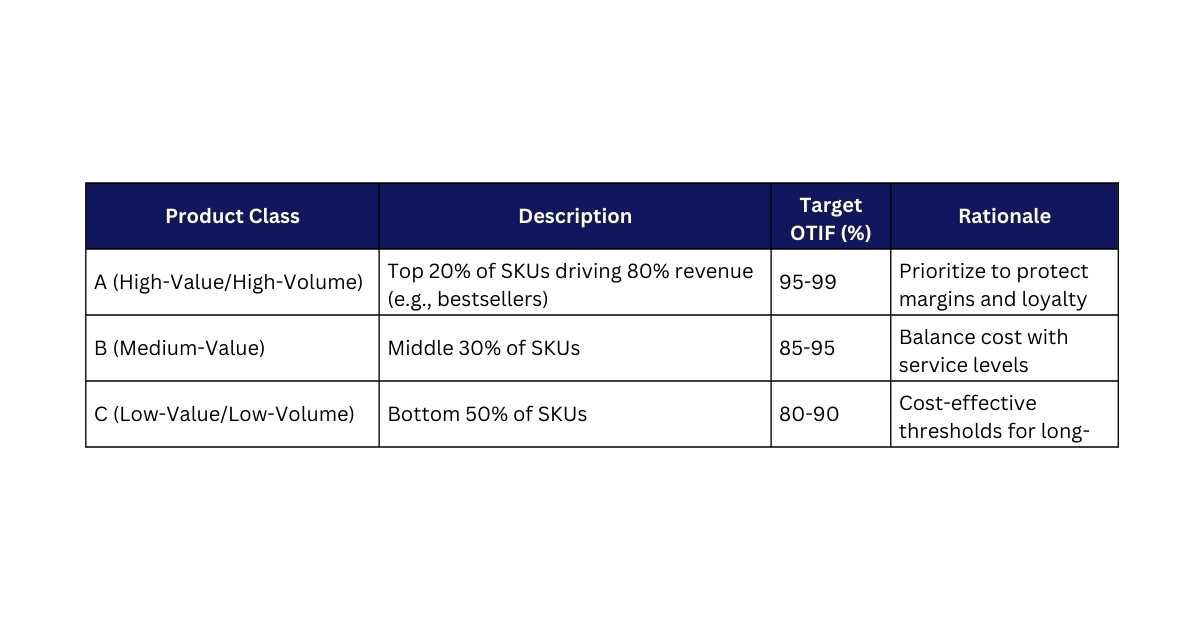
This tiered approach, adapted from inventory best practices, ensures resources focus where impact is greatest. Track monthly via spreadsheets or integrate with your warehouse management system (WMS) for automated dashboards. Pro tip: Segment by channel (e.g., Amazon vs. DTC) to uncover fulfilment-specific trends.
Signs It's Time to Track and Improve OTIF
You might not realize OTIF is slipping until complaints pile up, but there are early warning signs. If late deliveries are going up, it can be seen in customer service tickets or fewer positive reviews. This indicates there may be issues with the carriers or the processing. Similarly, inaccurate orders (wrong sizes, missing items) signal picking errors, erode trust, and inflate returns.
Lack of inventory visibility is another culprit: Frequent stockouts lead to split shipments, frustrating customers and inflating costs. Warehouse bottlenecks, like manual counting delays or understaffed peaks, compound this.
If your team spends more time on expedites than innovation, OTIF tracking becomes essential. Start with a baseline audit: Review the last quarter's data to quantify gaps, then set quarterly goals. For growing brands, partnering with a 3PL like a2b can provide instant visibility tools that turn these signs into actionable insights.
Proven Strategies to Improve Your OTIF Score

Boosting OTIF isn't about overhauling everything overnight, it's iterative tweaks across forecasting, processes, and tech. Drawing from industry leaders, here are seven battle-tested strategies tailored for ecommerce fulfilment.
1. Master Demand Forecasting and Inventory Optimization
Inaccurate forecasts breed stockouts, tanking "In-Full" rates. Leverage historical sales data, seasonal trends, and AI-driven tools to predict demand with 90%+ accuracy. Implement safety stock buffers for A-class items and just-in-time replenishment for others.
At a2b, our forecasting tools integrate with your ERP. This helps cut overstock by 15-20%. It also keeps shelves full without waste.
2. Streamline Order Processing with Automation
Manual entry errors delay picking and packing. Adopt an Order Management System (OMS) to automate intake, routing high-value orders to dedicated queues. Robotics for slotting and conveyor systems cut fulfilment time by 40%, per recent studies. For shippers, this means consistently meeting 1-day dispatch SLAs.
3. Foster Supplier and Carrier Collaboration
OTIF starts upstream. Share real-time visibility via portals to align replenishment with your forecasts. Negotiate OTIF clauses in contracts(e.g., 98% supplier target) and audit carriers quarterly. Tools like Four Kites provide ETAs down to the minute, preempting delays.
4. Distribute Inventory Strategically
Centralized warehousing works for startups but scales poorly. Use multi-location fulfilment to cut transit times. a2b's network across the US shaves days off delivery times, reaching 98% of the US in a 2-day ground network.
5. Enhance Visibility with Real-Time Tracking
Blind spots kill OTIF. Deploy IoT sensors for inventory and GPS for shipments to alert teams to deviations instantly. Customer-facing tracking portals build transparency, turning potential complaints into "on the way" reassurances.
6. Optimize Warehouse Layout and Staffing
Ergonomic designs and cross-training reduce errors. Use slotting algorithms to place fast-movers near packing stations, boosting pick rates by 25%. During peaks, flexible staffing through partners like a2b prevents bottlenecks.
7. Regularly Audit and Iterate Processes
Conduct root-cause analyses post-failure (e.g., 5 Whys) and A/B test changes, like packaging methods. Celebrate wins to maintain morale, small gains compound to 10-15% OTIF lifts annually.
Implementing these holistically can yield 95%+ scores within six months, as seen by our clients.
How a2b Fulfilment Can Supercharge Your OTIF
Why go it alone? a2b Fulfilment isn't just a 3PL, we're your OTIF accelerator. Our end-to-end services include automated WMS, multi-site distribution, and carrier integrations, delivering 99.9% on-time rates for partners. Ready to transform? Contact a2b today.
Frequently Asked Questions
What's the difference between OTIF and OTD?
OTD focuses solely on timeliness, while OTIF adds completeness, which is crucial for capturing the full order experience.
How does OTIF impact customer satisfaction?
Reliable OTIF builds trust, reduces churn by 15-20%, and boosts Net Promoter Scores through positive delivery experiences.
Can small ecommerce businesses afford OTIF improvements?
Absolutely! Start with free tools like Google Analytics for baselines, then scale with affordable 3PLs like a2b for outsized ROI.
In wrapping up, OTIF isn't a vanity metric; it's your ecommerce lifeline. By measuring diligently and acting strategically, you'll not only meet but exceed customer expectations, driving sustainable growth. At a2b Fulfilment, we're committed to making that journey seamless.